
Features / Specs
- Manufacturer: Seeed Studio
- Part Number: 113991054
- Main Chip: Espressif ESP32-C3FH4 (RISC-V 32-bit Single-Core Processor, Up to 160 MHz)
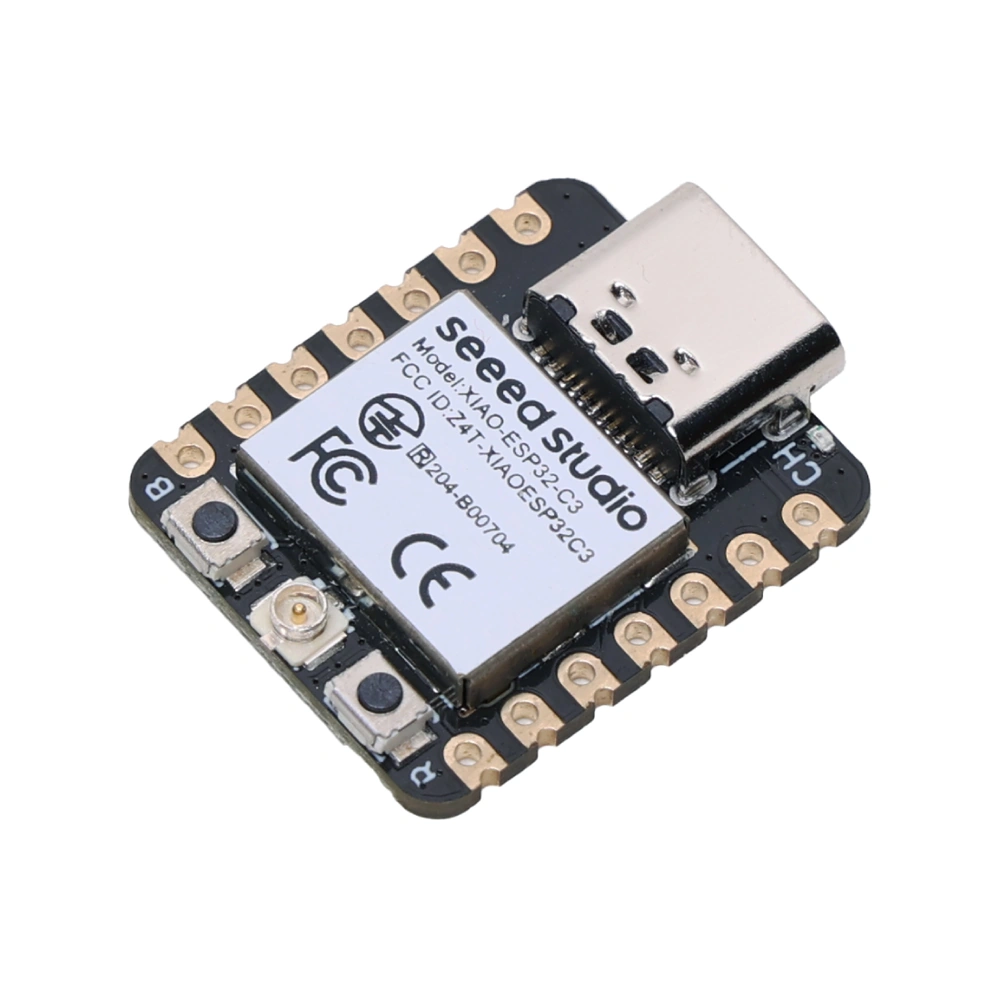
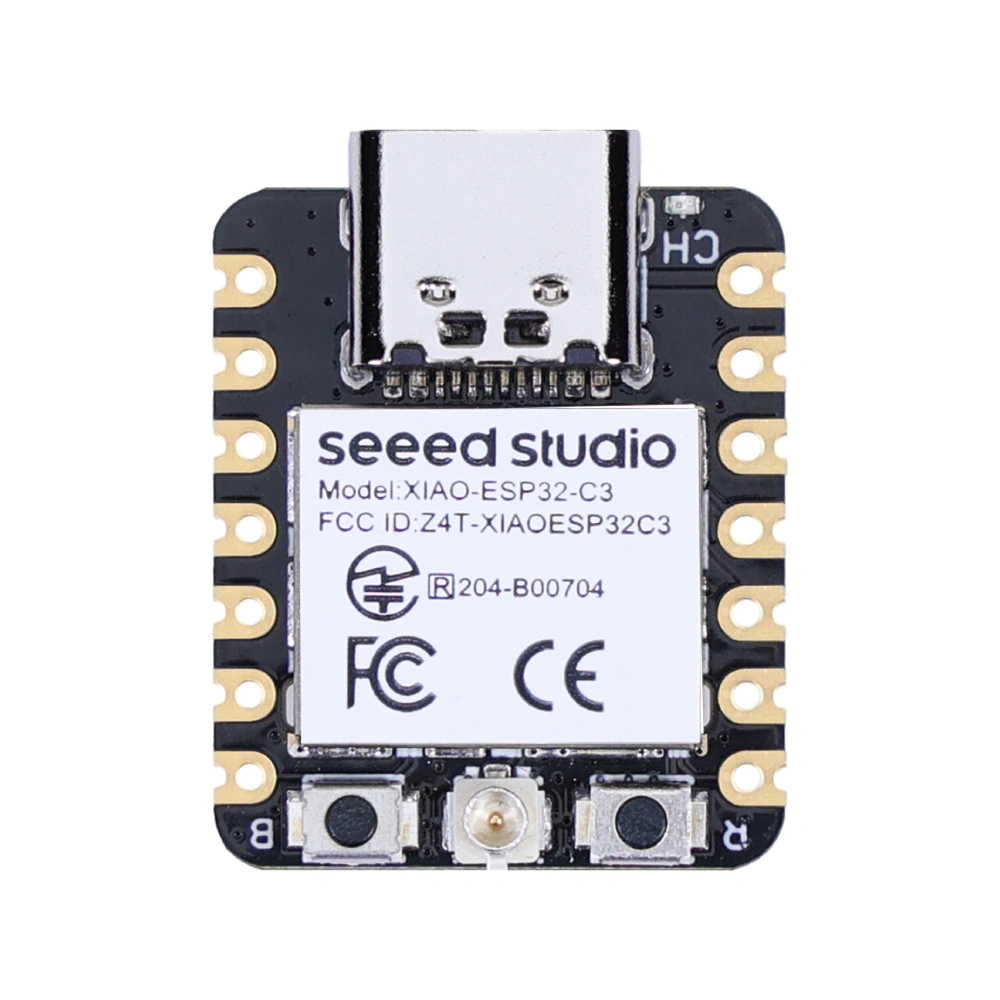
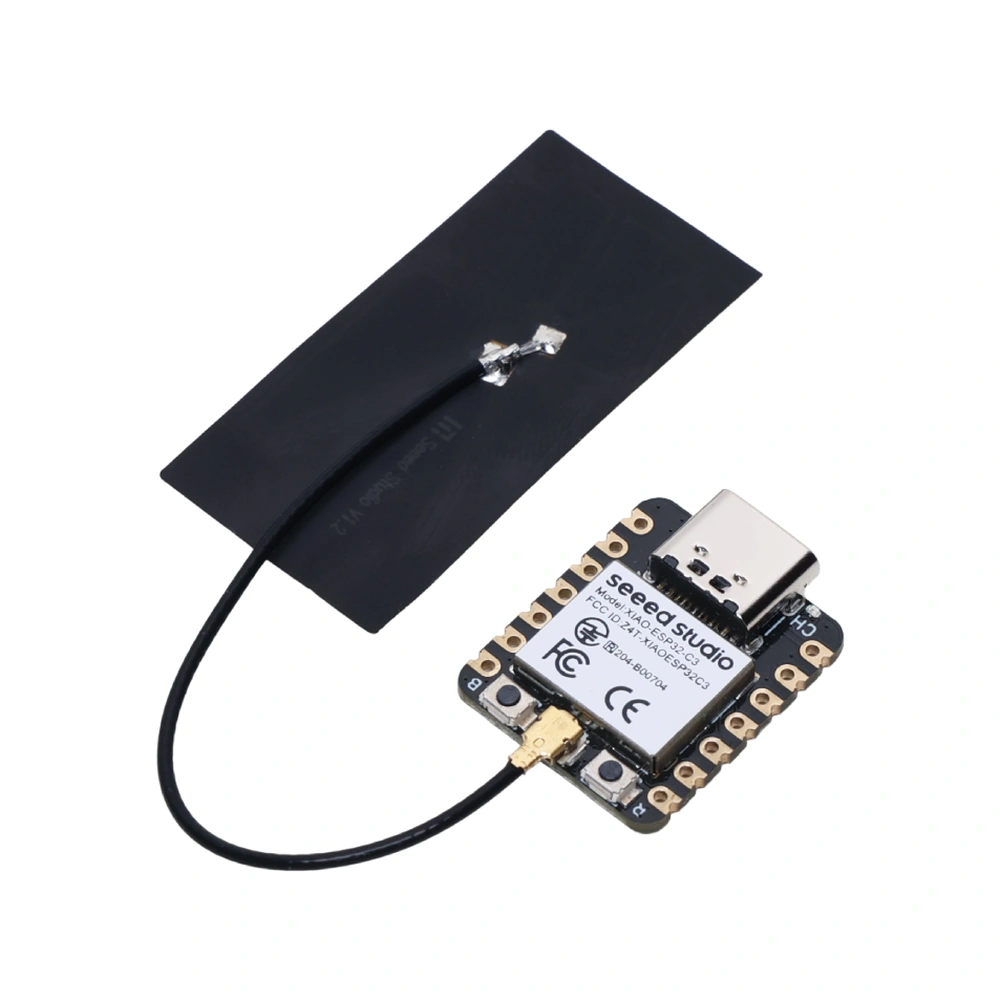
- Antenna: External FPC antenna (Seeed XIAO FPC Antenna A-01, included), connects to the onboard Male IPEX MHF-I / U.FL Socket (Hirose U.FL-R-SMT-1) – the board has no onboard antenna
- Flash Memory: 4 MB (in-package)
- ROM: 384 kB
- SRAM: 400 kB (16 kB used as cache) + 8 kB RTC SRAM
- USB Interface: USB Type-C, connected directly to the ESP32-C3’s built-in USB Serial/JTAG controller (USB 2.0 full speed, 12 Mbps) – no USB-to-UART bridge chip
- Power Input Options:
- USB Type-C Socket: 5 VDC, through an onboard 500 mA fuse (shared with the
VUSBpin) - VUSB Pin: Power input/output, connected directly to the USB Type-C VBUS line – an external 5 V source must be connected through a diode (Schottky, signal or power)
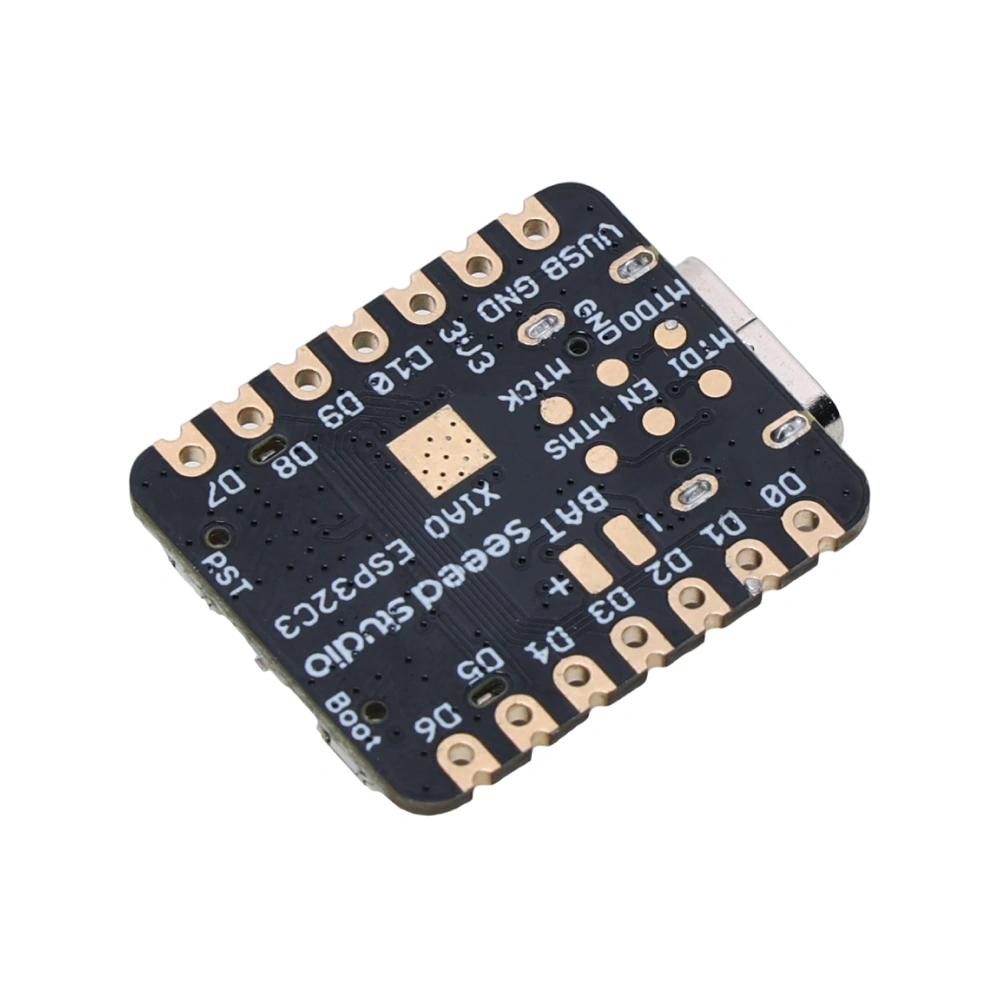
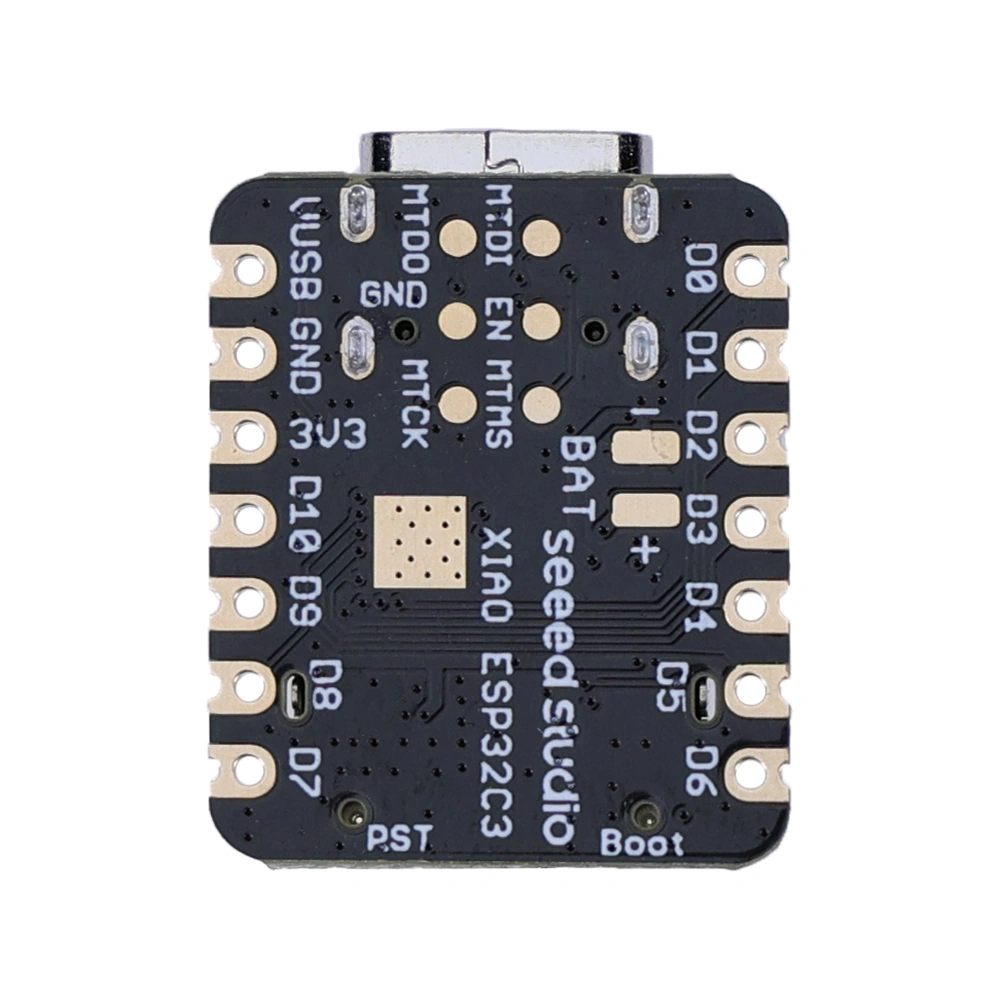
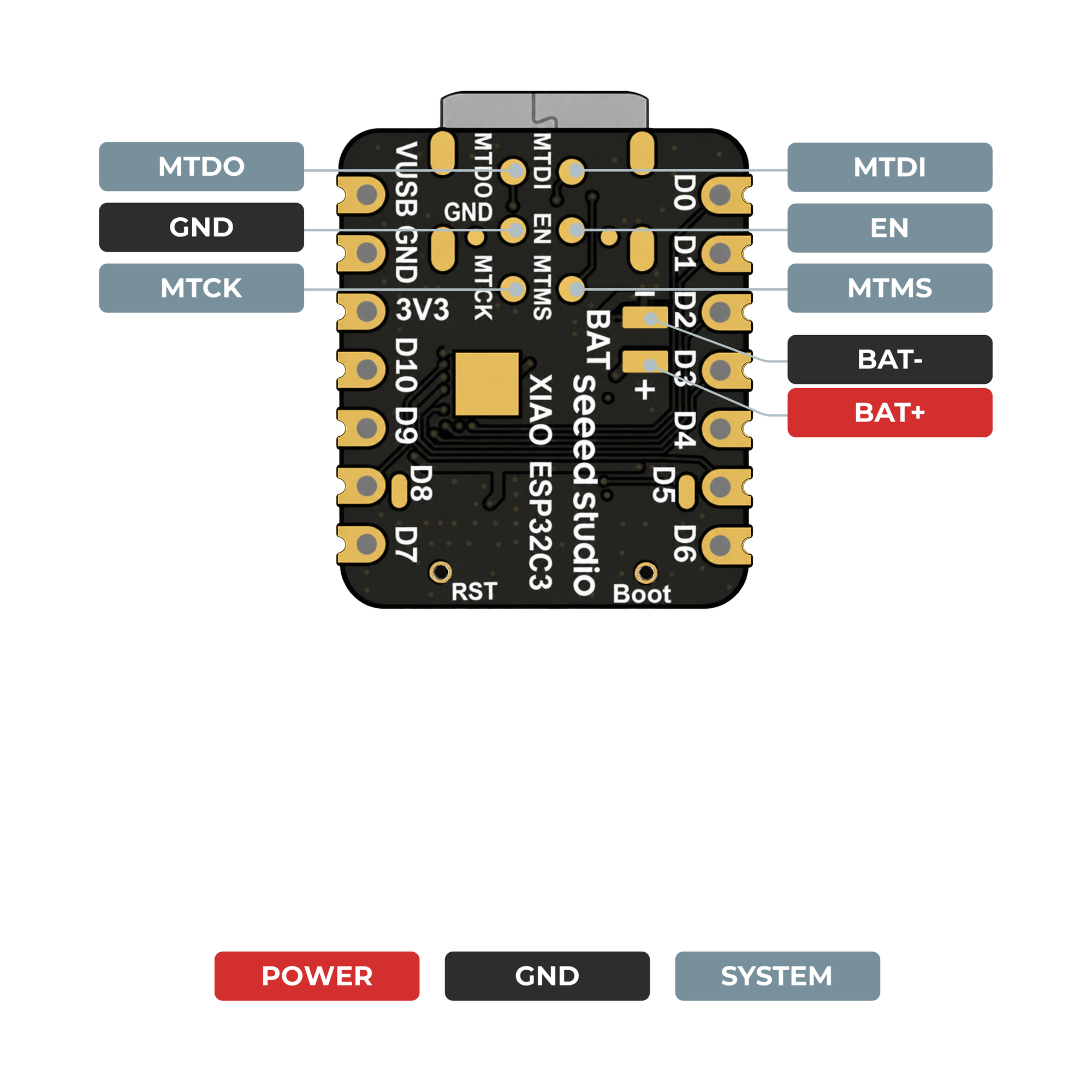
- Battery Pads: 3.7 V lithium battery, soldered to the BAT pads on the back of the board (no battery connector), charged by the onboard ETA4054 charger at 380 mA (fast) / 40 mA (trickle) – no battery voltage monitoring pin
- USB Type-C Socket: 5 VDC, through an onboard 500 mA fuse (shared with the
- Power Switching: Runs from USB (or the
VUSBpin) when connected, and from the battery otherwise – a diode stops the battery feeding back out of theVUSBpin - 3V3 Pin (Output): Regulated 3.3 V output from the onboard TLV75733P regulator, up to 500 mA (Seeed’s rating, tested with a 3.8 V battery input)
- Operating Voltage Range (Chip): 3.0 – 3.6 V (supplied at 3.3 V by the onboard regulator)
- I/O Logic Level: 3.3 V – inputs are rated to a maximum of VDD + 0.3 V, so the pins are not 5 V tolerant
- Standby Current (Typical): 44 μA (deep sleep)
- Communication Interface: USB / UART
- Programming Support: Arduino / MicroPython / CircuitPython
- Bootloader: Hold Boot while connecting USB to enter bootloader mode
- Operating Temperature Range: -40 °C to +85 °C
- Usable Peripherals (This Board): 11x programmable GPIOs (all PWM-capable) / 1x UART (UART0 on
D6/D7) / 1x I2C / 1x SPI / 4x ADC channels - Full Chip Capabilities (Not All Exposed on This Board): 22x programmable GPIOs (6 allocated to the in-package flash) / 3x SPI (SPI0 and SPI1 for flash, SPI2 general-purpose) / 2x UART / 1x I2C / 1x I2S / 2x 12-bit SAR ADC, up to 6 channels / 6x LED PWM channels / RMT, TWAI, GDMA, USB Serial/JTAG, temperature sensor
- GPIO:
- Usable: 11x programmable GPIOs on header pins
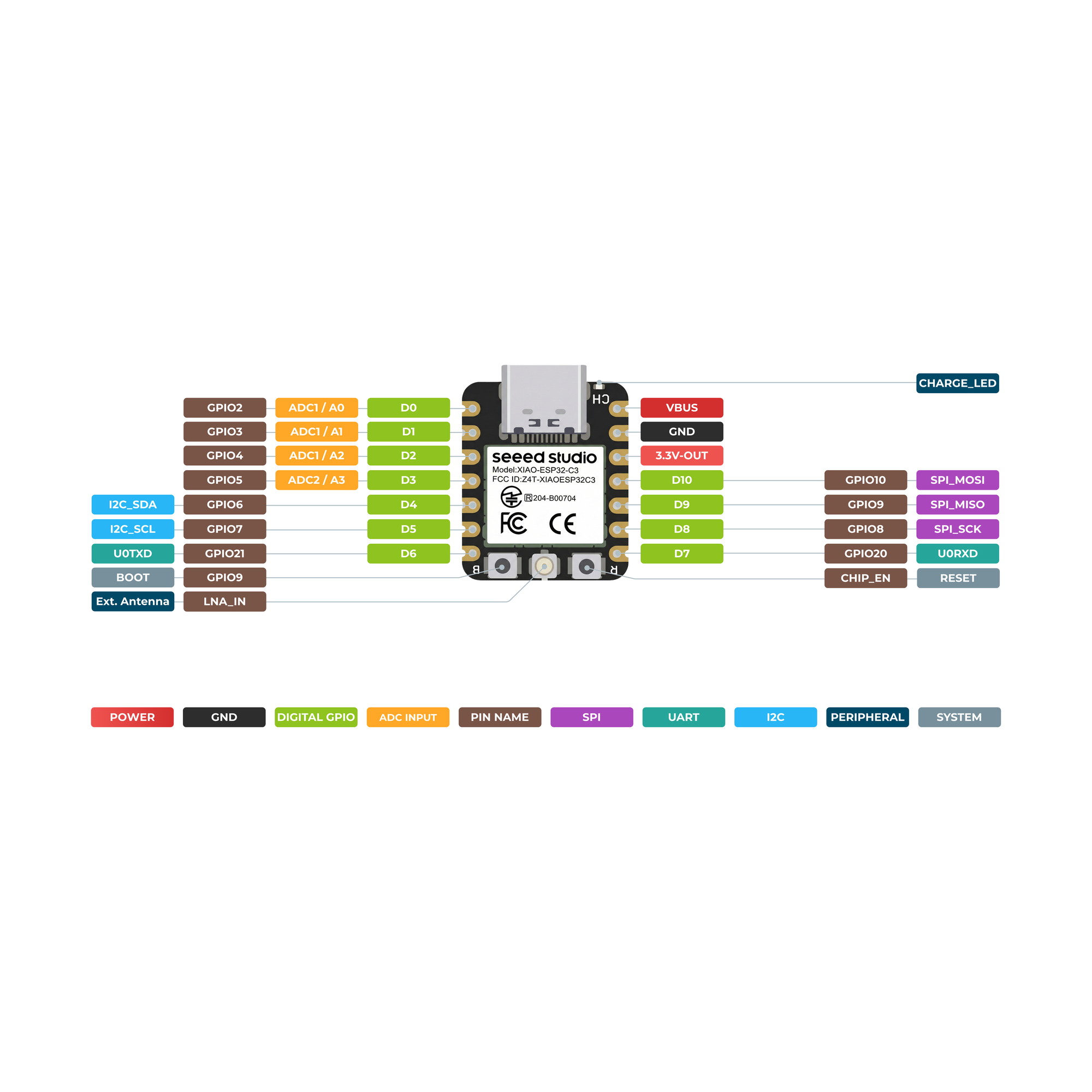
D0–D10(GPIO2/GPIO3/GPIO4/GPIO5/GPIO6/GPIO7/GPIO21/GPIO20/GPIO8/GPIO9/GPIO10) - Analog:
D0–D2use ADC1;D3uses ADC2, which Seeed warns may stop working due to false sampling signals (Espressif notes ADC2 is not factory-calibrated and is inoperable on some chip revisions) – useD0–D2for reliable analog reads - Strapping Pins:
GPIO2(D0) /GPIO8(D8) /GPIO9(D9, also the Boot button) – their levels at reset set the boot mode, so keep external circuits from pulling them the wrong way at power-up - Used Onboard:
GPIO0/GPIO1(32.768 kHz crystal),GPIO12–GPIO17(in-package flash) - Shared with USB:
GPIO18/GPIO19(USB D- / D+) are used by the USB Type-C port and are not broken out to the header - Debug: Built-in USB Serial/JTAG over the USB Type-C port; JTAG pads on the back of the board (
MTMS/MTDI/MTCK/MTDO/EN/GND), the same signals asD2–D5
- Usable: 11x programmable GPIOs on header pins
- Onboard Peripherals:
- Buttons: Reset, Boot (
GPIO9) - LEDs: Red charge LED – no user-programmable LED
- Buttons: Reset, Boot (
- Pin Description: Pinout diagram in the product images; full pin map in the linked Seeed wiki
- Certifications: FCC (FCC ID Z4T-XIAOESP32C3) / CE / Japan MIC (204-B00704)
- Dimensions (L x W x H): ~(21 x 17.8 x 4.5 mm)
- Number of Pins: 2x 7 pins (14 total)
- Header Pin Pitch: 2.54 mm
- Spacing Between Pin Rows (Centre to Centre): 15.24 mm
- WiFi Protocols: IEEE 802.11b/g/n
- WiFi Bandwidth: 20 MHz / 40 MHz
- WiFi Data Rate (Max): 150 Mbps
- WiFi Transmit Power (Max): +21 dBm (802.11b) / +20 dBm (802.11n)
- WiFi Modes: Station / SoftAP / Station + SoftAP / promiscuous
- Bluetooth Version: Bluetooth 5 (LE), Bluetooth mesh
- Bluetooth Data Rates: 125 kbps / 500 kbps / 1 Mbps / 2 Mbps
- Bluetooth Transmit Power (Max): +20 dBm
- Bluetooth Receive Sensitivity: -105 dBm @ 125 kbps